NFTs are coming back but Blue Chip projects are on life support


NFT trading activity showed signs of life in Q3 2025, breaking a long stretch of decline that defined the post-hype years.

After two years of contraction and shifting narratives, on-chain markets found a new footing, not in blue-chip collectibles or speculative art, but in cheaper rails, loyalty programs, and sport-linked assets that traded more on utility than status.

NFT trading volume rose in Q3 2025 and sales counts reached a high.

The center of gravity shifted to cheaper rails and utilitarian use cases as Ethereum’s scaling upgrade pushed activity to L2s, Solana leaned on throughput and compression, and Bitcoin inscriptions matured into a collectibles culture that waxes and wanes with fee markets.

Fees and distribution, not profile pictures, now set the boundary for growth.

Post-Dencun economics reset the map. Ethereum’s EIP-4844 cut data costs for rollups, pushing L2 transaction fees toward cents and enabling gasless or sponsored flows for mainstream-facing mints.

L2 fees fell by more than 90 percent in the wake of the upgrade, a shift already visible in mint behavior and the rise of Base as a distribution rail.

On Solana, compression brought mass issuance into range for loyalty and access use cases, with provisioning costs for 10 million compressed NFTs around 7.7 SOL and median transaction fees near $0.003 even under load.

Bitcoin inscriptions carved out a separate lane tied to mempool cycles and miner revenue, with more than 80 million inscriptions by February 2025 and a top-three position by lifetime NFT sales.

The demand side shows a rebound with a caveat.

DappRadar data shows that Q3 NFT trading volume almost doubled quarter over quarter to $1.58 billion as sales reached 18.1 million, an all-time quarterly high for transaction count.

Sports NFTs stood out, with sales up 337 percent quarter over quarter to $71.1 million, a pocket where schedulable utility, access and loyalty benefits drive spend independent of floor prices. The summer delivered a snapback before a cooldown.

Monthly sales hit $574 million in July 2025, the second-highest month of the year, then fell roughly 25 percent month over month in September as broader crypto risk appetite eased, based on CryptoSlam tallies.

The pattern reinforces a lower average sale value regime and shows how GMV tracks crypto beta even as unique users and utility categories hold up.

Distribution, not just fees, is doing more of the work. Wallets with embedded passkeys and sponsored fees remove onboarding friction that stalled prior cycles. Coinbase Smart Wallet supports passkeys and gas sponsorship in supported apps, and Phantom reported 15 million monthly active users in January 2025, a base that routes into mobile and social mint funnels.

That reach matters on chains where culture and social flows compound. Base is a case in point.

Base overtook Solana by NFT volume on some measures this year as cheap mints, Zora’s mass-mint cadence and Farcaster-adjacent funnels stacked up. The tilt explains why creators weighing where to drop are starting with distribution math, then back-solving into fee profiles.

Royalties no longer anchor the revenue stack.

Creator fees collapsed from 2022 peaks after marketplace wars made royalties optional across much of the market. According to Nansen, royalty receipts hit two-year lows in 2023 and did not recover to prior levels.

The counter-trend is the rise of enforcement-aligned venues. Magic Eden and Yuga Labs launched an Ethereum marketplace in late 2023 that enforces creator royalties, building a protected lane for brands that can command it.

The equilibrium is a bifurcated market, with low take-rates and primary sales, IP deals and retail tie-ins carrying most creator margins, while walled gardens capture premium drops where enforcement is contractual.

Marketplace share remains fluid where incentives drive order flow. On Solana, Magic Eden and Tensor trade leadership in a duopoly that swings with rewards schedules and program design, often ranging between roughly 40 and 60 percent share for each across periods.

This is less a structural change than a function of incentive epochs, which can make share charts look like a regime shift that later mean-reverts. The takeaway for creators is to negotiate distribution as part of launch planning rather than defaulting to a single venue.

Where users actually went tells the near-term roadmap.

Sports, tickets and loyalty programs are scaling because the benefits are schedulable and recurring, and the on-chain primitive, token-gated access, is already embedded in existing ticketing and e-commerce flows.

DappRadar’s Q3 breakouts show sports volumes outpacing the market, and that is before full-season or league-wide programs land.

Gaming is compounding more quietly. Immutable’s zkEVM stack and live metrics show steady transaction growth and a security-on-ETH, UX-on-L2 design that aligns with asset custody and recurring secondary fees, according to Messari.

IP and licensing is the other bridge from JPEGs to consumer channels. Pudgy Penguins’ expansion into more than 3,000 Walmart stores created a live pipeline from NFTs to physical retail and licensing cashflows,.

For creators deciding where to ship next, cost and UX by chain are now legible. ETH L1 still holds provenance and high-value art, with variable gas and optional royalties in most venues.

ETH L2s offer cents-level fees after Dencun, plus sponsored or gasless flows and social funnels on Base and Farcaster.

Solana’s compression brings millions of mints into dollar-level budgets with mobile-first wallet reach. Bitcoin inscriptions line up with scarce collectibles, where fee spikes are a feature, not a bug. The table below summarizes the current journey from mint to trade.

Step ETH L1 ETH L2 (e.g., Base) Solana Bitcoin inscriptions
Mint Variable gas under congestion Cents to sub-cents after EIP-4844, apps can sponsor Sub-penny typical, compression enables mass mints Tied to block fees and inscription size
List/Trade Gas plus optional royalties in most venues Cheap execution, social funnels on Base and Frames Cheap execution, high throughput, strong mobile UX Fees rise with demand, suited to scarce collectibles
Notes High-value art and provenance Culture and social distribution, gasless UX possible ~7.7 SOL for 10M compressed slots, median fee ~ $0.003 Collector beta relative to fee cycles

The macro mix is changing as well.

A $5–6.5 billion annualized run-rate in 2025, with average sale values in the $80–$100 range in the first half, sets the base from which next year’s scenarios extend.

Using CryptoSlam monthly sales as the spine and DappRadar category splits for color, a bear case lands at $4–5 billion GMV if crypto beta stalls and average sale values compress, with fee-sensitive use cases concentrated on Solana and ETH L2s, ETH L1 art steady, and inscriptions tracking Bitcoin fee cycles.

A base case in the $6–9 billion band requires embedded wallets and social mint rails to keep expanding, plus sports and live events scaling across seasons and brands testing royalty-enforced venues for new drops.

The bull case at $10–14 billion would need a step-change in mobile distribution, with Base and passkeys normalizing mint flows, Phantom monthly actives trending above 20 million, ticketing pilots moving into mainstream programs and gaming assets recurring.

In all three bands the share mix tilts toward ETH L2 and Solana, with ETH L1 narrower and Bitcoin stable as a collectibles lane.

Six toggles will decide how quickly that flow materializes.

  1. Wallet UX and distribution will be the lead indicator, measured by passkey adoption, sponsored fees and MAUs for Phantom and Coinbase Smart Wallet.
  2. The footprint of royalty enforcement matters for premium drops, including any OpenSea policy pivots and the health of creator-allied markets on Ethereum.
  3. Sports and ticketing partners that move from pilots to season-long programs convert one-off GMV into schedules.
  4. Base and Zora cadence, visible in monthly mints and Base’s share of NFT GMV alongside Farcaster Frames, shows whether social funnels sustain.
  5. Solana compression adoption, tracked by compressed mint counts and costs per million assets, signals whether loyalty and media programs go from experiments to defaults.
  6. Bitcoin fee cycles, and their link to inscriptions and Runes, will keep shaping collectibles pricing as mempool congestion ebbs and flows.

Two risks remain constant. Wash trading and spam minting still distort GMV and sales counts, which is why looking at average sale values and organic-filtered dashboards is the safer approach.

Marketplace incentives can make share charts look like regime change when they are just airdrop cycles, especially on Solana’s duopoly, so launch plans should price that churn in from the outset. The other operational constraint is revenue design.

With royalties mostly optional in open markets, primary sales, IP licensing and retail are carrying more of the load, while enforced venues create a premium lane that some brands can utilize and most cannot.

What looked like an end state in 2023 turned into a migration.

The JPEG boom is over, the rails got cheaper, the use cases now line up with tickets, sports, gaming and IP, and the wallet and distribution stack is starting to meet users where they already are.

The Blue Chip flagship NFT, Bored Ape Yacht Club remains in a perilous state for those who invested six figures into AWS hosted jpegs. The NFT below sold for over 74 ETH in 2021 but is now worth just 9 ETH, an 87 percent decline in three years.

Bored Ape Yacht Club NFTs
Bored Ape Yacht Club NFTs (Source: OpenSea)

Speculation may be over for the non-fungible sector, but will this finally allow the underlying technology to gain traction in real world utility applications? Only time will tell, but the signs are promising, just not for the bag holders.

Q3 closed with $1.58 billion in trades and 18.1 million sales, and the mix is already moving in that direction.

Mentioned in this article


Source link

Can Solana handle 100M Western Union users sending dollar tokens worldwide?


Western Union will distribute a Solana-based stablecoin to its 100 million-plus customers starting in the first half of 2026, pairing Anchorage Digital Bank’s federally regulated issuance with a global on/off-ramp network that converts crypto wallet balances to local cash.

Announced on Oct. 28, this model challenges the neutral-infrastructure strategies deployed by Visa and Stripe.

The US Dollar Payment Token represents a test of whether vertical integration can bring blockchain remittances to mass adoption, where crypto-native protocols have struggled to gain retail traction.

Solana processes USDC transfers at sub-cent costs and settles in seconds, yet most cross-border senders still route payments through traditional money transfer operators or correspondent banking networks.

Western Union’s plan embeds Solana rails inside a branded product with physical distribution, betting that control over issuance, compliance, and cash access will overcome the adoption barriers that have kept stablecoin remittances confined to crypto users.

End-to-end settlement versus neutral rails

Visa and Stripe built stablecoin infrastructure as open platforms that enable third parties to issue tokens and transact across multi-chain networks.

Visa integrated USDC settlement on Ethereum in 2021, then expanded to Solana in 2023, allowing merchant acquirers, including Worldpay and Nuvei, to settle with Visa in stablecoin.

The company added support for PYUSD, Paxos’ USDG, Circle’s euro stablecoin, and the Stellar and Avalanche networks in July 2025, positioning its platform as a settlement layer beneath card transactions that does not issue proprietary tokens.

Visa also operates VTAP, an API-driven stack that lets regulated banks mint and manage fiat-backed tokens.

Stripe re-enabled crypto payments in 2024, processing USDC on Ethereum, Solana, and Polygon, and auto-settling to merchants’ Stripe balances.

The company acquired Bridge in 2025 and launched Open Issuance, a white-label service that allows businesses to issue compliant stablecoins with reserve management and liquidity orchestration handled by partners.

Bridge filed for a US trust bank charter to embed regulatory compliance into the platform, mirroring Anchorage Digital Bank’s role in Western Union’s plan but serving developers and merchants rather than remittance customers.

Western Union’s approach consolidates issuance, distribution, and cash conversion under a single brand.

USDPT will run on Solana, with Anchorage Digital Bank as issuer and custodian, and will be distributed through partner exchanges and Western Union’s Digital Asset Network.

The network connects crypto wallets to Western Union’s agency locations across more than 200 countries and territories, letting customers send USDPT from a wallet and pick up cash in local currency at a retail agent.

Western Union will also accept other digital assets through the network, positioning the infrastructure as a last-mile solution for any crypto holder who needs fiat access.

The economics of that vertical model differ from neutral infrastructure. Visa and Stripe earn fees on transaction flow but do not capture the float on stablecoin reserves or control the end-user relationship.

Western Union will earn on USDPT issuance, transaction fees, foreign-exchange spreads, and agent commissions, stacking revenue across the payment chain.

The company’s existing customer base provides distribution, but converting users who already transact in fiat to a stablecoin-first flow requires education, trust, and incentives that traditional remittance pricing may not offer.

Can Solana remittances go mainstream?

Western Union selected Solana for USDPT based on throughput and cost. Solana processes transactions in under a second with fees measured in fractions of a cent, making micro-remittances economically viable where Ethereum’s variable gas costs create friction.

Anchorage Digital Bank’s involvement addresses custody and reserve management, providing federally regulated infrastructure that meets US compliance standards and enables Western Union to market USDPT as a bank-issued product.

The choice of Solana over multi-chain support distinguishes Western Union’s strategy from Visa and Stripe, which treat chain selection as a configuration option rather than a strategic commitment.

Visa supports Ethereum, Solana, Stellar, and Avalanche; Stripe supports Ethereum, Solana, and Polygon.

Western Union’s single-chain launch simplifies technical integration. Still, it locks the company into Solana’s ecosystem, creating dependency on network performance and limiting interoperability with stablecoins on other chains unless Western Union later bridges USDPT or adds support for competitor tokens.

The Digital Asset Network aims to solve the problem that crypto-native protocols have not solved: converting blockchain balances into spendable cash in jurisdictions where card infrastructure is sparse and bank accounts are uncommon.

Western Union operates more than 600,000 agent locations, many in markets where digital payments remain secondary to cash.

The network will let wallet users, including non-Western Union customers, access that footprint, converting USDPT or other digital assets to local currency with Western Union’s compliance stack managing KYC and AML requirements.

Adoption barriers and competitive pressure

Western Union faces execution risk on multiple fronts. The company must integrate wallet partners, educate customers on stablecoin usage, maintain regulatory compliance across jurisdictions with divergent crypto rules, and compete on price with both traditional money-transfer operators and crypto-native services.

USDC transfers on Solana already undercut Western Union’s pricing in corridors where both sender and receiver hold crypto wallets. Still, adoption has concentrated among crypto users rather than mainstream remittance customers.

Visa and Stripe avoid adoption friction by embedding stablecoins into existing user interfaces.

Visa processes stablecoin settlement invisibly within card transactions; Stripe lets merchants accept stablecoins and receive fiat in their Stripe balance without interacting with wallets or chains.

Western Union’s model requires customers to hold USDPT in a wallet, then initiate a transaction to the Digital Asset Network for cash pickup, adding steps relative to Western Union’s current mobile app, which handles fiat-to-fiat transfers without blockchain exposure.

The company bets that lower cost and faster settlement will offset that complexity, particularly in high-volume corridors where pricing sensitivity drives customer behavior.

Competitive pressure also comes from other remittance providers exploring stablecoin integration.

MoneyGram partnered with Stellar in 2021 to enable USDC cash-in and cash-out at retail locations, though the program has not scaled to match MoneyGram’s core business.

Smaller fintech operators, including Veem and Pangea Money Transfer, support stablecoin payments, positioning them as alternatives to traditional wire services.

Western Union’s scale provides an advantage, but success depends on execution rather than distribution alone.

Western Union’s partnership with Anchorage ensures USDPT meets US banking standards. Still, the company must also navigate international regulations as it rolls out the Digital Asset Network across jurisdictions with varying stablecoin rules.

The European Union’s Markets in Crypto-Assets regulation imposes reserve and transparency requirements. Jurisdictions, including India and China, restrict or ban the use of stablecoins.

Western Union’s compliance expertise in traditional remittances provides a foundation, but extending that to on-chain operations introduces new legal and operational complexity.

The success of USDPT will test whether branded, vertically integrated stablecoin infrastructure can drive mainstream adoption where open protocols have not.

The outcome depends on whether Western Union’s 100 million customers will adopt on-chain payments and whether the Digital Asset Network can deliver the reliability and cost savings necessary to compete with both traditional operators and crypto-native services.

Mentioned in this article
Posted In: Solana, Crypto


Source link

Cryptocurrency is as ‘property’ under Indian law, rules Madras High Court


Madras High Court rules cryptocurrency is a “property”
  • Madras High Court confirms crypto can be owned and held in trust.
  • WazirX has been barred from redistributing investors’ unaffected XRP holdings.
  • Ruling strengthens investor rights and Web3 governance in India.

In a landmark ruling that could reshape cryptocurrency in India, the Madras High Court has declared that cryptocurrencies qualify as property under Indian law.

The Court’s decision, delivered by Justice N. Anand Venkatesh, affirms that cryptocurrencies can be owned, held in trust, and protected as legal property — a major step in clarifying the legal status of digital assets in the country.

Cryptocurrency in India now recognised as property

The case arose from a petition by an investor whose 3,532.30 XRP coins were frozen after a cyberattack on WazirX, one of India’s largest cryptocurrency exchanges.

In July 2024, the platform suffered a $234 million hack involving Ethereum and ERC-20 tokens.

While the investor’s XRP holdings were not part of the stolen assets, WazirX sought to redistribute all users’ funds under its so-called “socialisation of losses” plan.

Justice Venkatesh firmly rejected the proposal, ruling that each investor’s digital holdings are individual property and cannot be diluted or redistributed to cover exchange losses.

He emphasised that cryptocurrencies, though intangible, possess all the essential attributes of property — they are identifiable, transferable, and exclusively controlled through private keys.

“It is not a tangible property nor is it a currency,” the judge observed. “However, it is a property, which is capable of being enjoyed and possessed in a beneficial form.”

This interpretation grants digital asset holders stronger legal standing, ensuring that their cryptocurrencies are recognised as assets protected under Indian law.

Jurisdiction and investor protection

The Court also settled questions over jurisdiction, dismissing WazirX’s argument that Singaporean arbitration rules applied because its parent company, Zettai Pte Ltd, is based in Singapore.

Justice Venkatesh cited the Supreme Court’s earlier decision in PASL Wind Solutions Pvt Ltd v. GE Power Conversion India Pvt Ltd (2021), noting that Indian courts have authority over assets located within India.

Because the investor’s transactions originated from Chennai and involved an Indian bank account, the Court confirmed that the case fell squarely under Indian jurisdiction.

The court further highlighted that Zanmai Labs Pvt Ltd, which operates WazirX in India, is registered with the Financial Intelligence Unit (FIU) — unlike its foreign parent company or Binance.

This distinction reinforced that Indian exchanges operating domestically are subject to Indian oversight and accountability, particularly in protecting user assets and maintaining transparent custodial practices.

Strengthening Web3 governance

Justice Venkatesh’s decision went beyond individual relief to call for higher standards of corporate governance in the Web3 and crypto sectors.

He urged exchanges to maintain separate client funds, conduct independent audits, and uphold robust KYC and anti-money laundering controls.

These measures, the Court noted, are vital for building trust in the digital economy and protecting consumers from future mishandling of assets.

Legal experts hailed the judgment as a milestone in developing “crypto-jurisprudence” in India.

Vikram Subburaj, CEO of Indian exchange Giottus, described it as a foundational moment that signals to all market participants — exchanges, users, and regulators — that the digital asset space will be held to strong standards of governance and protection.

A foundation for India’s crypto future

The Court’s ruling not only protects the rights of individual investors but also strengthens the broader regulatory framework around digital assets.

By recognising cryptocurrency as property, the judgment fills a crucial legal gap in a country where tax enforcement on crypto remains strict, but investor protections have lagged.

As Justice Venkatesh wrote, courts now serve as the “central stage where the future of digital value is debated.”

Through this ruling, the Madras High Court has given India a clearer picture of ownership, responsibility, and trust in the age of decentralisation.

With cryptocurrency in India now firmly recognised as property under Indian law, the decision marks a turning point for the country’s digital asset ecosystem — affirming that in India, crypto holdings are not just speculative instruments but protected assets under the law.


Source link

Mt. Gox delays Bitcoin repayments again as creditors await full settlement


Mt. Gox delays Bitcoin repayments again as creditors await full settlement
  • Mt. Gox extends Bitcoin repayment deadline to Oct 2026 amid ongoing administrative hurdles.
  • Once the top Bitcoin exchange, Mt. Gox’s collapse in 2014 led to the loss of 850,000 BTC.
  • Arkham data shows holdings now down 75% to 34,690 BTC.

Mt. Gox, once the world’s largest Bitcoin exchange, has delayed repayments to its creditors until October 2026 — extending a saga that began more than a decade ago.

The announcement, made just days before its previous deadline of October 31, 2025, reflects ongoing administrative and technical challenges in finalising payments.

While many creditors who submitted paperwork have received partial repayments, a significant number are still waiting for their funds.

The Tokyo District Court approved the extension after the trustee cited the need for additional time to process remaining claims and complete settlements efficiently.

Delayed Bitcoin repayments extended to 2026

According to the latest notice, the Mt. Gox rehabilitation trustee confirmed that most base, early lump-sum, and intermediate repayments have been processed for creditors who completed the required steps.

However, repayments for others remain pending.

The trustee explained that it was “desirable to make the repayments to such rehabilitation creditors to the extent reasonably practicable,” leading the court to approve a new deadline of October 31, 2026.

This marks another chapter in one of the cryptocurrency industry’s longest-running recovery efforts.

Mt. Gox, which once handled over 70% of the world’s Bitcoin trading volume, collapsed in 2014 after a massive hack led to the loss of approximately 850,000 BTC.

The company subsequently filed for bankruptcy in Japan.

How the Mt. Gox collapse reshaped Bitcoin history

When Mt. Gox failed, the exchange’s bankruptcy shook investor confidence in digital assets and exposed vulnerabilities in early crypto infrastructure.

About 200,000 BTC were later recovered, but 650,000 BTC remain missing.

The recovery process transitioned into a court-supervised civil rehabilitation in Japan, during which a trustee began redistributing recovered Bitcoin and Bitcoin Cash (BCH) in 2024.

At the time of its collapse, Mt. Gox’s influence was unmatched.

The incident not only caused a sharp decline in Bitcoin prices but also prompted tighter regulatory oversight in key markets.

In the years since, it has become a landmark case in crypto regulation, bankruptcy law, and investor protection — shaping how global exchanges handle custody and insurance.

Market impact and sell-off concerns

With repayments scheduled to continue into 2026, traders and analysts have debated whether the eventual release of thousands of Bitcoin could trigger selling pressure.

Historically, such fears have surfaced each time Mt. Gox announced repayment progress.

However, recent on-chain data suggests that these effects may be limited.

According to Arkham Intelligence, Mt. Gox currently holds 34,690 BTC worth nearly $4 billion, down from about 142,000 BTC in mid-2024 — a decline of more than 75%.

Analysts tracking these wallets have noted that even large movements from the exchange have had only short-term effects on Bitcoin’s market price, indicating that most creditors are choosing to hold rather than sell immediately.

What’s next for creditors and the crypto market

The trustee’s revised timeline means that full repayments could now take another year, extending the wait for thousands of claimants worldwide.

For many early Bitcoin investors, the repayments represent not only financial recovery but also closure on one of crypto’s most notorious events.

Still, the Mt. Gox story continues to serve as a cautionary tale for digital asset investors.

It underscores the importance of secure custody, transparent operations, and regulatory compliance — principles that have since become standard practice across global crypto exchanges.


Source link

Battle for a green month: Can Bitcoin hold its gains as ‘Uptober’ comes to a close?


Battle for a green month: Can Bitcoin hold its gains as 'Uptober' comes to a close?
  • Bitcoin is fighting to close October in positive territory, a key historical signal.
  • The month has been highly volatile, with a 13% correction at one point.
  • A series of technical indicators are now pointing to a bullish short-term structure.

It has been an up-and-down and often frustrating month for Bitcoin traders, a period of wild price swings that has put the seasonal promise of an “Uptober” rally to a severe test.

Now, with just a few days left in the month, a tense battle is underway as the bulls fight to keep the world’s leading cryptocurrency in positive territory, a goal that could have significant implications for the rest of the year.

Historically, October has been a powerful launchpad for Bitcoin, delivering average gains of more than 20%. But this year has been a different story.

After spiking above $123,000 early in the month, the market was hit by a brutal 13% correction that saw prices plummet to $107,000.

Since then, the bulls have been in a grinding, hard-fought recovery, with the price currently hovering around $115,000, a meager 1.14% gain for the month.

A powerful macro tailwind provides support

This fragile recovery is being supported by a powerful macroeconomic tailwind.

Traditional markets are firing on all cylinders, with the S&P 500 hitting fresh record highs as investors confidently price in a quarter-point interest rate cut from the Federal Reserve this week.

This dovish monetary policy, combined with an easing of US-China trade tensions, has propelled a “risk-on” sentiment that typically benefits assets like crypto.

Adding another layer of support is a renewed wave of institutional interest.

Spot Bitcoin ETFs have now recorded their third consecutive day of inflows, a clear signal of conviction from the market’s larger and more influential players.

The view from the charts: a bullish structure takes shape

A deep dive into the technical charts reveals a bullish short-term structure that suggests the path of least resistance is now to the upside.

The Average Directional Index (ADX), a key measure of trend strength, is sitting at a strong 32.14, a reading that suggests the current upward momentum is likely to persist.

At the same time, the Squeeze Momentum Indicator is flashing a “bullish Impulse,” a high-probability signal that directional movement to the upside is just beginning.

The Ichimoku Cloud analysis also shows Bitcoin trading above the clouds, another classic indicator of trend continuation.

The final hurdle: a pivotal Fed decision

While the technical and macro pictures are aligning in favour of the bulls, a major and binary risk event looms on the horizon: the Federal Reserve’s policy announcement on Wednesday.

While the market is pricing in a 25-basis-point cut, any hawkish language about the future path of interest rates could easily trigger a wave of short-term volatility.

The key for the bulls will be whether Bitcoin can maintain its critical support above the $114,000 level through any Fed-related turbulence.

If it can, then this “Uptober,” while not as explosive as many had hoped, may still end in the green, setting the stage for a potentially powerful final two months of the year.


Source link

Bitcoin, Ethereum Fluctuate as US Inflation Hits 8.5%, Slightly Above Expectations

Bitcoin, Ethereum Fluctuate as US Inflation Hits 8.5%, Slightly Above Expectations

Source: Adobe/noskaphoto


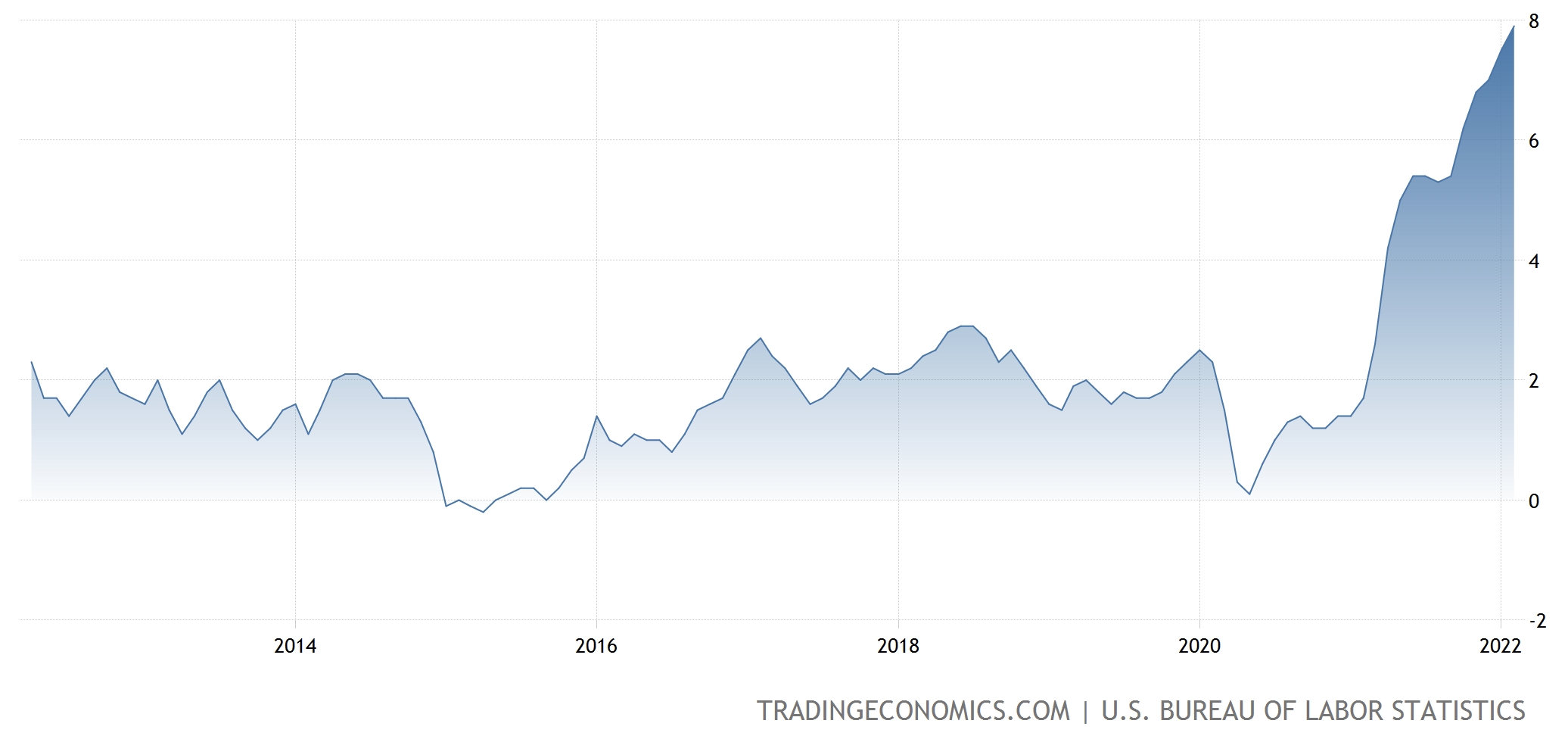
The price of both bitcoin (BTC) and ethereum (ETH) moved higher before reversing lower today as inflation for March accelerated to 8.5% compared to the same month last year, slightly exceeding analysts’ expectations. The number was also up markedly from February’s reading of 7.9%.

“The all items index continued to accelerate, rising 8.5 percent for the 12 months ending March, the largest 12-month increase since the period ending December 1981. The all items less food and energy index rose 6.5 percent, the largest 12-month change since the period ending August 1982,” the US Bureau of Labor Statistics wrote in its latest inflation report.

While the headline inflation came in slightly above expectations, core CPI came in slightly below it. Analysts’ expectation for the headline inflation last month was 8.4%, while the core CPI was expected at 6.6%, once again marking the highest inflation in the US since the early 1980s.

Headline inflation is the commonly quoted inflation number that includes all consumer prices, while core CPI excludes prices on food and energy.

US headline inflation rate last 10 years:

The BTC price initially reacted to the slightly higher-than-expected inflation reading by moving about 0.7% higher in the first 10 minutes after the release, while ETH saw a spike of about 1.5%. However, the market later reversed to the downside, with BTC once again dipping testing the key USD 40,000 level.

At 14:30 UTC, BTC was down 1.3% since the announcement, trading at USD 39,850. Meanwhile, ETH was down by 0.5% over the same time period to USD 3,019.

At the same time, the S&P 500 stock index was up by 0.85% for the day.

Ahead of the release of the inflation number, crypto markets were already trimming losses after heavy selling on Monday. Similarly, S&P 500 stock index futures in the US also pointed up slightly after a red day yesterday.

According to Marcus Sotiriou, an analyst at the UK-based digital asset broker GlobalBlock, the recent weakness in the crypto market can mainly be put down to the current macro headwinds at hand.

“With soaring inflation, retail investors do not have enough money to invest significant amounts in what they deem as ‘risky’ assets like cryptocurrencies,” he said in an emailed note.

Today’s inflation report comes after energy prices in particular have risen strongly in the wake of Russia’s full-scale attack on Ukraine, which began on February 24.

The figure was also released after White House spokesperson Jen Psaki yesterday said the administration expects headline inflation for March to be “extraordinarily elevated.”

Psaki added that they expect to see “a large difference between core and headline inflation,” and that this comes as a result of disruptions to global energy and food markets as a result of the war in Ukraine.

Commenting ahead of the release of today’s inflation number, the former Twitter CEO and current CEO of payments firm Block, Jack Dorsey, hinted that the official response to the high inflation is one of “deception and zero accountability.”

“It’s not the party, it’s the system,” he said.

Commenting to the Wall Street Journal ahead of the release, Blerina Uruci, US economist at investment management firm T. Rowe Price Group Inc., said inflation now has “strong momentum across the board,” and that it affects both goods and services.

“To me, this is a red flag. The other red flag is Russia’s invasion of Ukraine and the rise of Covid in China. Those pose risks that the so-called normalization of supply chains takes longer to materialize,” Uruci was quoted as saying.

Meanwhile, other analysts say they believe the high inflation reading in March represents a peak for the current cycle of elevated inflation.

“[We] believe CPI will peak in March (also peaking on a quarterly basis with Q2 @ 7.9% yr/yr) as higher year-ago base effects take hold and the pace of overall economic growth slows which should lead to price growth easing on a sequential basis this summer,” Sam Bullard, managing director, and senior economist at banking giant Wells Fargo, said in a note on Sunday cited by U.S. News.
___
Learn more: 
– When Bitcoin Meets Inflation
– Get ‘Mentally Ready’ for Lower Bitcoin Prices as Rates Rise, Bitcoin 2022 Panelists Warn

– How War in Ukraine Is Increasing Inflationary Pressure Across World’s Regions
– Fed Can’t Stop Prices From Going Up Anytime Soon, But There’s Good News, Too

– ‘New Inflationary Era’ Upon Us, Central Bank Action Will be Unpopular – BIS’ Carstens Warns
– War in Ukraine to Make Countries Rethink Currency Dependencies – BlackRock CEO
___
(Updated at 14:38 UTC with the latest market data.)


Margex Teams Up With ChangeNow – The No KYC Dynamic Duo of Crypto Exchanges

Margex Teams Up With ChangeNow – The No KYC Dynamic Duo of Crypto Exchanges

Did we mention that all you need is a credit card to purchase crypto? Oh, and a wallet to send it to!

Disclaimer: The following article is part of Cryptonews Deals Series and was written as a promotional article in collaboration with the sponsor of this offer. If your company has an exclusive promotion that you would like to share with our readers, we invite you to reach out to us. Let’s build together.


We’ll start by stating how simple it is to create an account and start buying/trading crypto on Margex. So, we are doubly excited to announce that crypto derivatives trading platform Margex has teamed up with crypto swap service ChangeNow, because the goal of this partnership is to offer you easier access to crypto. Who doesn’t love simplicity – especially in the world of crypto?


Margex – About Us

In short, Margex’s key benefits are the ability to trade anonymously, margin trading at 100x leverage, and an innovative Price Manipulation security feature, along with currency purchasing options for multiple coins. If you want to learn more about Margex, there’s an in-depth look at the exchange here. That’s where ChangeNow comes in.  

ChangeNow is a platform that allows you to buy crypto using your credit card. Your crypto is received as quickly as the blockchain can process it. Where does your crypto go from there? You can choose to send it to whatever wallet you choose. They also offer a native, non-custodial wallet, meaning that the exchange does not collect or store your crypto. Being a non-custodial exchange adds to the transparency and security of the platform because you are in control of your assets.


Now, given this new powerhouse of a partnership, buying crypto via fiat on Margex will not only be easier but have the added benefit of being able to purchase a variety of coins/tokens. See, Margex has always provided fiat purchases – but only for BTC. Of course, you can always buy BTC and exchange it for another currency. With ChangeNow added to your fiat purchasing options – you may choose from a variety of coins and tokens. That’s right – decentralized finance (DeFi) as well.

When you’re using Margex to buy crypto, you will now see (in the drop-down menu of the upper-right corner) a second option for buying crypto – not just Bitcoin. ChangeNow is the second option in that drop-down menu. After selecting ChangeNow a new window will open and you will now be on the ChangeNow exchange window for fiat purchases. The Margex wallet address will already be populated in the ‘Recipient Wallet’ field, or you can add in your preferred address. When you are on ChangeNow’s purchasing page, you will be able to change currency purchasing options. ChangeNow offers over 50,000 buy/sell options.


In conclusion, this partnership is a great on-ramp for anyone who wants to buy into crypto but isn’t quite sure how. The process is secure, fast, and simple. It is also beneficial for the more seasoned investor who wants to broaden their portfolio’s tools, or wants a fresh face in terms of exchanges. Simply put, you won’t feel the type of purchasing freedom anywhere else, thanks to a powerhouse of a partnership like this!

Are you ready to start buying and/or trading using Margex? Check out the Special Offer that we have below. Don’t miss out on this deal!

Special Offer: Join and get a USD 50 bonus to pay trading fees. Deposit 0.004+ BTC to get an additional USD 100 bonus! To get your deposit bonus, simply send the promocode CRYPTONEWS to our team in live chat.

See our original post with details on our promotion here.


Coinbase Faces Criticism Again for Listing ‘Dead’ and ‘Stupid’ Tokens

Coinbase Faces Criticism Again for Listing ‘Dead’ and ‘Stupid’ Tokens

Source: Coinbase


The major US-based crypto exchange Coinbase is again facing criticism from the community after it released a new list of tokens it said are “under consideration for listing.” The list includes projects that a community member described as “stupid” and “virtually completely dead.”

Among the tokens that Coinbase revealed it is considering for listing in the second quarter of this year were largely unknown Ethereum (ETH)-based ERC-20 tokens such as StudentCoin (STC), Polkamon (PMON), and Big Data Protocol (BDP). In addition, there are 42 other ERC-20 tokens and 5 Solana (SOL)-based tokens.

Sharing his take on Twitter today, the popular crypto influencer Cobie called Big Data Protocol a project that was “virtually completely dead prior to [the] listing blog post.”

He added that Big Data Protocol was a project that earlier got some attention when Tron (TRX) founder Justin Sun and crypto trading firm Alameda Research “farmed it with billions.” However, everything came to a full stop when the smart contract “accidentally locked people’s assets” because of a bug in the code.

“Nobody really heard about it ever again after that week,” Cobie said.

On the same note, Cobie also attacked StudentCoin, calling it “a great 2017-ICO-style name.”

“What does it do? Did they rebase supply or did it dump 80% and never recover?? Nobody knows, except Coinbase Listings Team,” Cobie said.

The outburst from the popular influencer today came after he has long criticized Coinbase over their listing practice. Last month, he jokingly said the exchange might just add something “stupid like ‘StudentCoin’ next.”

Today, that prediction appears to have come true.

Eric Wall, chief investment officer at crypto hedge fund Arcane Assets jokingly replied to the tweet, that: “Obviously Coinbase added StudentCoin because of this tweet to reverse-farm Cobie for likes or something.” 

Similarly, other leading members of the crypto community also called out the exchange.

Business is booming for Coinbase

Despite the backlash, listing the ever-increasing number of what many consider to be questionable tokens may have been good for Coinbase’s business.

The company, which is now publicly listed on the Nasdaq stock exchange under the ticker COIN, reported its highest quarterly revenue ever in the 4th quarter of 2021 of USD 2.5bn.

The revenue is up from just USD 585m during the same quarter in 2020, while the company’s net income has risen from USD 177m in the 4th quarter of 2020 to USD 855m in the 4th quarter of 2021.

Coinbase quarterly revenue and net income:

Source: TradingView

According to Coinbase’s blog post announcing the token list, the exchange’s goal is to “list every asset possible that meets our standards for legal, compliance and technical security.”

It further says that their listing considerations “do not take into account” the market capitalization or popularity of a project.

____

Learn more:
– Coinbase Ranks Top Among Crypto Exchanges, ‘Oligopoly’ Seen on Horizon
– Coinbase Halts India’s UPI Support After Regulatory Uncertainty

– Coinbase Launches New Debit Card Amid Intensified Competition Among Exchanges, Platforms
– NFT Entertainment Accelerates: BAYC Film Trilogy and Snoop Dogg’s NFT Collection on Cardano

– Coinbase Reportedly Nears Mercado Bitcoin Purchase as Binance Readies Rio Expansion
– ADA Rallies as Coinbase Offers 3.75% APY for Staking Cardano

– As More Russians Support Massacre in Ukraine, Here’s How Some Big Crypto Companies Respond
– Two Crypto Lawsuits to Watch: Meta and Coinbase Enter New Legal Battles


ViaBTC Capital|Gitcoin Grants Round 13: ZK Projects

ViaBTC Capital|Gitcoin Grants Round 13: ZK Projects

Disclaimer: The text below is an advertorial article that was not written by Cryptonews.com journalists.

Through Gitcoin, which is the largest fund-raising and construction platform for Web 3.0, creators and builders of Web 3.0 projects can obtain funding from community users. As of the end of March, there are over 2,400 projects and 312,000 active developers on Gitcoin, with a fundraising amount of USD 54.6 million. Gitcoin Grants is a regular crowdfunding event held by Gitcoin that allows community users to invest in promising new projects without any quota. Gitcoin Grants Round 13 (GR13), which started on March 9 and ended on March 24, featured more than 800 projects that were classified by tags. In particular, there were over 20 projects under the zkTech tag.

zkTech projects refer to projects focusing on zero-knowledge proof (ZKP) that are early-stage, open-source, or public goods. ZKP is playing an increasingly important role in the blockchain space. For instance, Zcash, a noted privacy-preserving project, uses ZKP to protect users’ transaction privacy. Meanwhile, ZKP has also been recognized for its importance for Ethereum scaling. Vitalik has praised ZK Rollup, a ZKP-based project, on many occasions and even considers it to be a long-term solution for Ethereum’s Layer 2 (https://zeroknowledge.fm/120-2/). According to statistics from L2BEAT (https://l2beat.com), among the top 10 Layer 2 projects (by TVL), four are ZK projects, including zkSync, dYdX, and Loopring. Today, we will cover over 20 ZK projects under the zkTech tag and dive into the ZK world.

Community Education

Project: learn.0xparc.org 

Website: https://0xparc.org/

The 0xPARC Foundation promotes R&D and education & ecosystem development on Ethereum and other decentralized applications. Projects it funds, provides operational support for, or is otherwise involved in include Dark Forest, EthUniversity, Reboot, and Project Sophon. 0xPARC collected learning resources from learning groups that apply ZK makes them available at learn.0xparc.org. Offering resources such as Prerequisite Materials, Lectures, and Demos, the website is a platform of learning resources featuring constant updates. It aims to provide the best resources for ZK enthusiasts. The funds 0xPARC receives from GR13 will be mainly used to support administrators and volunteers in maintaining the resources of the entire project.

Project: ZK Travel Scholarships 

Website: https://0xparc.org/

Similar to student grants, the project was also founded by the 0xPARC Foundation. 0xPARC plans to work with Stanford Center for Blockchain Research to fund cryptography students or researchers, enabling them to attend ZK conferences or other crypto events. The project aims to bring researchers closer to the blockchain community by engaging them in Ethereum and blockchain community events and conferences, thereby enabling the ongoing basic research for the long-term application of blockchain.

Project: Blaine Bublitz

Website: https://github.com/phated

Blaine Bublitz is a special project that directly funds the work of Blaine Bublitz, an active ETH/ZK infrastructure and ecosystem developer who has contributed to the development of several open-source ZK tools.

Project: ZK HACK

Website: https://www.zkhack.dev/mini.html

ZK Hack is a short-term online event platform featuring introductory workshops and advanced puzzle-solving competitions. Participants can learn how to use ZK tools on this platform.

Project: MoonMath Manual to zk-SNARKs

Website: https://leastauthority.com/

Least Authority, a consulting firm focusing on security services, provides MoonMath Manual to zk-SNARKs for an audience with minimal experience in cryptography and programming, helping readers implement complex ZK designs from step to step.

Project: zkApe

Website: https://zkape.substack.com/

zkApe, a Turkish newsletter about zero-knowledge, releases project developments, updates, publications, and podcasts about zero-knowledge technology from time to time.

Development

Project: Circom

Website: https://iden3.io/circom

Circom is a major circuit programming language and a compiler that allows programmers to design and create their own arithmetic circuits for ZK proofs. The first version of Circom was developed in 2018 by Jordi Baylina from iden3, a tech team focusing on Ethereum scaling solutions. As a major development tool for ZK technology, Circom has been successfully used for building several projects, including Tornado Cash, Dark Forest, Polygon Hermez, and many more.

Circom is a novel domain-specific language that aims to provide developers with a holistic framework to construct arithmetic circuits through an easy-to-use interface and abstract the complexity of the proving mechanisms. In particular, CircomLib is an open-source library of templates provided with hundreds of circuits such as comparators, hash functions, digital signatures, binary and decimal converters, etc. All templates defined in the Circom libraries have been manually proved and are guaranteed to be safe by construction. Circom helps programmers work in a modular fashion by defining small pieces and combining them to create large circuits that describe complex real-world problems. In addition, users can also create their own custom templates.

Project: CirC 

Website: https://circ.dev/

CirC is a compiler infrastructure that supports compilation from high-level languages to circuits. For instance, it has been used to compile to .

Project: ZKxZK

Website: https://0xparc.org/blog/zk-ecdsa-1

ZKxZK is an open-source effort funded by the 0xPARC Foundation that aims to implement efficient proof-of-concept ZK circuits for Elliptic Curve Cryptography (ECC) and Pairing Based Cryptography (PBC) through Circom. The funds obtained from GR13 grants will be mainly used for renting servers to run the required programs.

Project: ZKML 

Website: https://github.com/0xZKML/zk-mnist 

ZKML plans to develop zkSNARK circuits about machine learning through Circom. The project was conceptualized and launched during the first learning group of 0xPARC in 2021.

Project: Zk Block

Website: https://zkblock.app/

This project sets out to help developers focus on developing quality ZK Dapps by building a unified ZK template (called zkblock) that supports the latest web development technologies and ZK’s common code base.

Project: zkREPL

Website: https://zkrepl.dev/ 

zkREPL is an online playground for zero-knowledge circuits based on zk-SNARK. With zkREPL, both beginners and experts can freely practice and build new and creative ZK designs. zkREPL is also a web-based SNARK development environment. Members of the community may use the tool to collaborate on building circuits of increasing complexity. Moreover, the project also serves as a testbed for new developer experience features. For instance, on zkREPL, users can mouse over any variable to see its value, like a continuous debugger for zero-knowledge circuits.

Application

Project: ZeroPool

Website: https://zeropool.network/

ZeroPool is a multi-chain DApp that allows sending fully anonymous, cheap, non-custodial transactions. ZeroPool recently has partnered up with Gnosis Chain (formerly xDai Chain), which will build privacy functions into EVM and cross-chain bridges through ZeroPool technology.

Project: Otter Cash

Website: https://otter.cash/

Otter Cash is similar to Solana’s Tornado Cash, but transaction fees on Otter Cash are much cheaper (less than USD 1). 

Project: zkC.R.E.A.M

Website: https://zkcre.am/

zkC.R.E.A.M allows the average Japanese citizen to vote in a completely anonymous fashion while maintaining the integrity and verifiability of the final vote tallies. The project has received a grant from the Ethereum Foundation, and the DEMO has been released on its official website. zkC.R.E.A.M will later announce a user-friendly desktop version, as well as a mobile client.

Project: ZK Data Marketplace

Website: https://modulozero.xyz/

ZK Data Marketplace is a ZK-based data market. Here is how the market works: Sellers first promise that the data they sell meets certain computational properties, then buyers lock the tokens in custody, and finally sellers encrypt the data using buyers’ public key and submit a ZK proof to make sure that the data is consistent with the promise. If the data turns out to be valid, sellers receive tokens and buyers get data.

Project: Decentralisedvoting 

Website: https://github.com/EDGDrummond/DeVo/blob/main/DeVo.pdf

Decentralisedvoting is an infant project that has only released its whitepaper so far. It plans to implement a decentralized anonymous voting system based on PLONK’s circuit and MPC. The project uses keys to generate and share vote tallies, thereby enabling more DAOs to transition to a decentralized governance structure.

Conclusion

GR13’s zkTech projects are mainly divided into three categories. In particular, community education projects account for about one third of the total, including learning group materials and grants provided by 0xPARC, as well as ZK HACK’s online events. Development tools also account for about one third, which primarily cover infrastructures such as the Circom circuit programming language and some code bases. This is the case probably because ZK comes with a high threshold in terms of development. As such, there are only a few developers and development tools. Therefore, the community hopes to integrate more resources and train more ZK developers through different ways to improve the relevant development tools.


Elon Musk Offers to Buy 100% of Twitter, Calls it ‘Best and Final Offer’

Elon Musk Offers to Buy 100% of Twitter, Calls it ‘Best and Final Offer’

Elon Musk. Source: A video screenshot, Youtube, Bloomberg.


Tesla CEO Elon Musk has reportedly offered to buy 100% of Twitter at a price of USD 54.20 per share, after taking a stake of 9.2% earlier this month. 

Musk’s offer would value Twitter at close to USD 43.4bn, up from a current market capitalization of USD 36.7bn. It would also mean that the company would no longer be a publicly listed company, and instead become one of America’s most valuable privately-owned companies.

Musk reportedly called the offer his “best and final offer,” the Wall Street Journal reported, quoting the largest shareholder of Twitter as saying that “If it is not accepted, I would need to reconsider my position as a shareholder.”

Writing in a letter to Twitter Chairman Bret Taylor that was disclosed in a securities filing, Musk said:

“I invested in Twitter as I believe in its potential to be the platform for free speech around the globe, and I believe free speech is a societal imperative for a functioning democracy.”

Musk is known as an active Twitter user and free-speech proponent who has previously voiced dissatisfaction about the way Twitter handles freedom of speech issues on its platform.

Meanwhile, Twitter is also the main social media platform used by the crypto community to share ideas and discuss developments in the space.

The outspoken CEO has also used the social media platform extensively to tweet about crypto, including his views on bitcoin (BTC) and – arguably his favorite coin – dogecoin (DOGE).

DOGE immediately jumped on the news today, rising by more than 6% before giving back some of its gains. As of 11:20 UTC, the ‘meme coin’ traded for USD 0.1438, up 3.8% for the past 24 hours.

Recently, Musk bought a 9.2% stake in Twitter, becoming the company’s largest shareholder. Following the investment, Musk was offered a seat on the company’s board by Twitter CEO Parag Agrawal, but declined the offer.

Following the Msk’s rejection of Agrawal’s offer for a seat on the board, the CEO shared a note that he sent to Twitter employees, saying “There will be distractions ahead […].” The note was interpreted by some to mean that Twitter’s top management could already sense that Musk was planning a takeover of the company.

Twitter’s stock closed at USD 45.85 on Wednesday. Musk’s offer would indicate a rise of approximately 18% for the stock from current levels.

____

Reactions:

____
Learn more: 
– Musk Not Joining Twitter’s Board But Wants ‘Significant Improvements’, Teases DOGE Payments Integration
– Elon Musk Won’t Sell Bitcoin, Ethereum, Dogecoins as Inflation Soars and Recession Risk Grows

– VCs Fight Back as Jack Dorsey, Elon Musk Attack ‘Web3’ Narrative
– Elon Musk Should Listen to Cathie Wood on Bitcoin

– Facebook, Watch Out! Aave and Twitter’s Bluesky Move Towards New Social Media Standard
– Post-Dorsey Twitter Adds Tipping in Ethereum

____
(Updated at 11:31 UTC: updates throughout the entire text.)